


Quality Assurance (QA) Testing determines if a game is released to players in a polished state or if the game ends up being reported as a liability.
This article explains the contents of QA testing, the impacts QA testing has on regulated iGaming platforms, and where the QA testing benefits can be found on the Profit and Loss (P&L) statement.
Our entire research is backed by peer-reviewed articles, and no suggestions are made on a hypothetical basis.
The igaming license of an operator can be lost due to a single miscalculated payout. This is the primary risk QA testing was designed to eliminate. During the game development process, QA is not simply a phase that is added on before the game release.
QA is the support that is required for every build, patch, and certification cycle. For iGaming platforms, QA testing determines whether a game ever reaches a player in a real-money context when regulators analyze salary, payout, and Return to Player (RTP) data.
What Is QA Testing in Game Development?
QA testing in game development encompasses functionality verification, or if the button actually has a function, compliance review, as well as payout verification. It also sits inside a broader game testing process that includes playtesting, regression passes, and platform certification. In game development, QA is the umbrella discipline of testing, which can and should be considered one of the many components.
Even though this process is extremely important, fewer formal studies exist about it. One example of a formal study is a 2021 survey of video game bug testing. This specific study screened over 327 published research papers and found only 71 that met their rigorous inclusion criteria.
This study concluded that video game testing and QA significantly lag behind general software QA and that a process and methodology for video game testing and QA are still lacking in the industry. This is why companies that treat video game testing and quality assurance seriously have a huge advantage in effectively testing video games for bugs.
How Does QA Testing Protect iGaming Platforms?
For the operators of legal iGaming, QA testing is the compliance layer. Operators typically account for the cost of multiple game submissions because games frequently fail certification tests for Random Number Generators (RNG) or Return to Player (RTP) levels. Submissions can cost $5,000 - $8,000 and delay launch by an additional three to four weeks. Issues with the game’s source of entropy, along with the RTP being out of the acceptable range, are the most frequently seen issues. Repeated failures of certification tests can put an operator’s entire gaming license at risk, not just the gaming title in question.
Global gambling revenues were estimated to be $133 billion in the year 2029, with a growth rate of 5.42%. Every delay in certification of gaming QA tests, the loss is greater as the market expands at a rate faster than the compliance teams can work.
At this scale, multiple layers of checks are necessary to secure a platform. A mature game testing company with this process for iGaming usually consists of five different testing techniques:
The five testing approaches that make up a mature QA testing process for iGaming platforms.
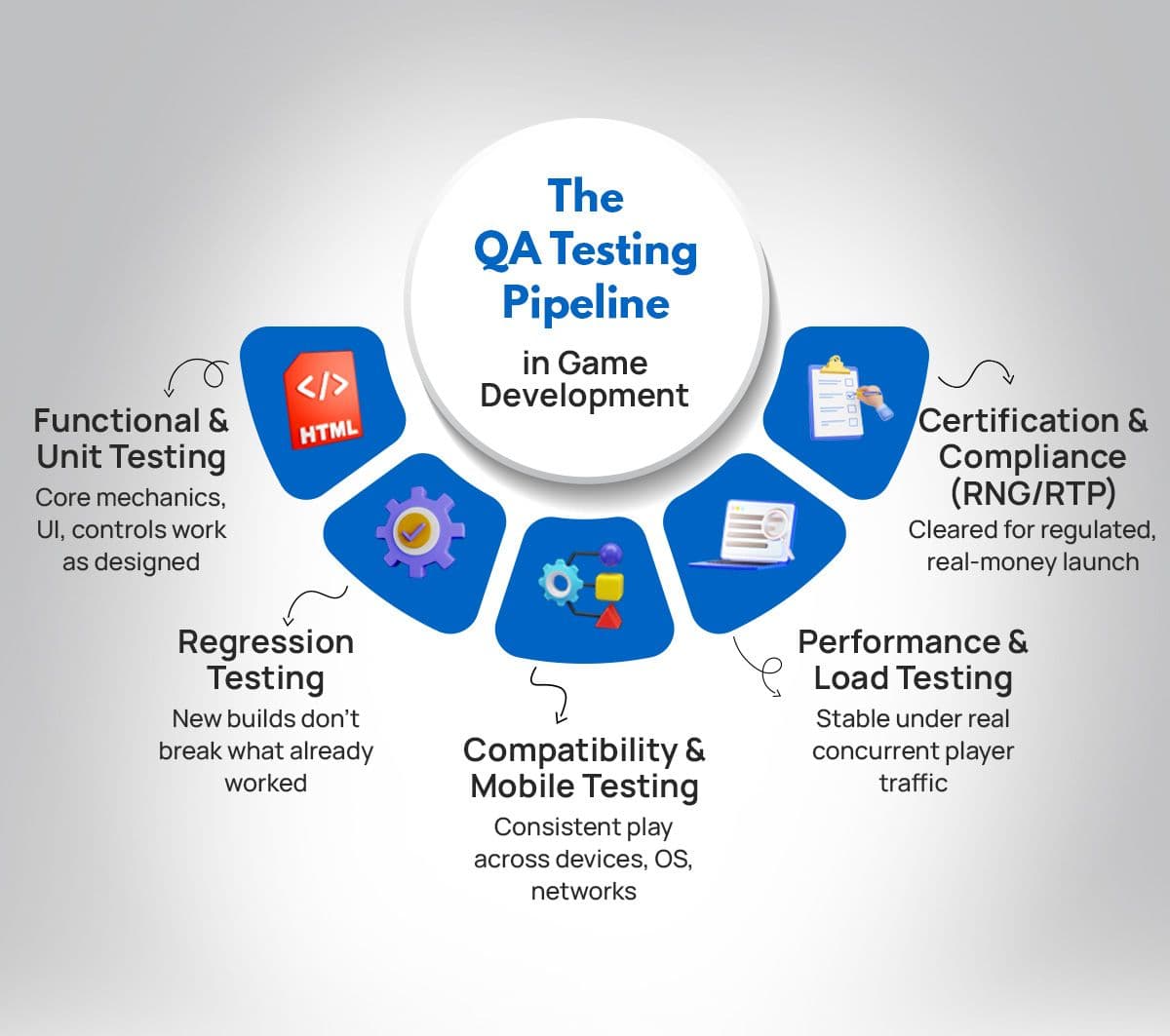
Functional and Unit testing
This step covers the testing of fundamental game mechanics. This also tests the UI and controls to ensure they behave as expected.
Regression testing
This checks to see if a new game build or patch stops the game from functioning in a previously tested state.
Compatibility and Mobile Game testing
Consistent levels of play are tested across different devices, operating systems, and even differing levels and types of connectivity.
Performance testing
This checks game stability for concurrent players under the conditions of real-world play.
Certification requirements & compliance testing.
This ensures the game meets the stochastic (random) system requirements, return to player (RTP) requirements, and meets the requirements set by each gaming regulatory authority for a real-money gaming launch.
A shift toward automating the testing methodology layers is supported by research. A 2025 review of the testing practices in the video game industry described how, in the past, game studios relied on testing practices of manual brute force, but, with the introduction of multiplayer and cloud gaming, game studios have begun adopting automated testing tools and frameworks to control costs
Benefits of QA Testing
Quality assurance testing can save time and increase revenue when done properly. Here’s how:
Reduced post-launch fixes
The expenses associated with game patches post-release dwarf the costs of identifying issues using game bug testing services.
Quicker certification
Game testing services streamline the process and reduce the number of RNG/RTP submission cycles and the associated costs.
Improved player retention
The first game session is the most critical in preventing uninstalls and ensuring the game’s stability.
Preserved brand image
The stability of a game on launch day directly correlates with day-one game reviews.
Stable gaming experience on different devices
The mobile game testing services ensure a game is stable and playable on any hardware and network.
Adaptive compliance
As a game developer adds more markets and regions, the automated game testing services and performance testing services help maintain compliance.
Adaptive workforce
Game testing services help teams absorb sudden certification surges while preventing a permanent workforce increase.
Bottom Line
QA testing is more than just a last-chance check before launch. It's the most important part of the whole process. In general game development, it means reducing bugs, less game churn, and meeting deadlines. However, for regulated iGaming, QA testing can make the difference between a game passing RNG and RTP certification on the first try or spending weeks and thousands of dollars on multiple submissions.
Treating testing as the final stage is a game of chance. Research shows companies that integrate testing through assurance and structure maximize their potential with a platform. These companies achieve fewer fixes after a game is launched, quicker game reviews, and a gaming platform that is better developed.
If your team is looking for QA testing for a release - whether it's functional testing, regression, compatibility, or checking certification - that's exactly the type of game QA outsourcing SolveByte pointed to top 10 QA companies in igaming. Reach out before your next deadline for submissions (and after failed attempts).