


Choosing the best iGaming license for new operators is the single decision that shapes your budget, your target markets, and how long banks and payment processors take you seriously. Curacao's regulator overhauled its entire licensing regime this year, the UK raised its gaming duty to 40%, and Anjouan added new dispute-resolution rules, so a comparison written even twelve months ago is already outdated.
This guide breaks down MGA license requirements, Curacao's new LOK framework, the UKGC's fee bands, and Anjouan's fast-track process, using the latest 2026 figures.
An iGaming license is a legal authorization issued by a gaming regulator that permits an operator to offer real-money casino, betting, or poker products to players in specific markets. It typically covers technical certification, AML compliance, and player-fund protection, and its jurisdiction determines which countries an operator can legally serve.
Why Jurisdiction Still Decides Your iGaming License Cost Comparison?
Cost is rarely the whole story. According to studies, licensing signals to players that an operator "adheres to appropriate standards and is accountable to jurisdictional laws," while also keeping tax revenue inside the regulator's home country. That trust signal is worth more in payment processing and banking relationships than the license fee itself.
Industry coverage backs this up: as iGaming Business notes in its 2026 jurisdiction roundup, the era of "picking the cheapest license and launching the next day" is over — operators now weigh prestige, speed, and long-term compliance flexibility together.
MGA License Requirements: The Premium Route
The Malta Gaming Authority license remains the most respected credential for operators targeting the EU and UK-adjacent markets. Applicants pay a one-time €5,000 application fee, then €10,000–€25,000 annually depending on license class, plus a compliance contribution starting at 1.25% of gaming revenue (minimum €15,000/year).
Add capital requirements of €40,000–€100,000 and platform costs, and a realistic first-year budget lands near €2,50,000. Approval takes 4–12 months due to rigorous fit-and-proper checks, business-plan review, and a pre-launch system audit covering RNG and wallet security.
Curacao Gaming License 2026: New Rules, New Costs
Curacao replaced its old master/sub-license system with the National Ordinance for Games of Chance (LOK), regulated directly by the Curacao Gaming Authority (CGA). The Curacao gaming license 2026 now requires a physical local office and local staff, scaling to three employees by year five, though full enforcement was pushed to April 2027.
Application costs €4,592 (non-refundable), with an annual B2C fee of €47,450 split between the national treasury and CGA supervisory charges. Most projects should budget €80,000–€110,000 for year one. Worth noting: the CGA's supervisory board resigned in September 2025 and the reform's architect left office amid corruption allegations soon after, so operators should watch this jurisdiction's stability closely.
UKGC Online Casino License: Prestige at a Price
A UKGC online casino license provides access to a top regulated market but has become significantly more expensive in 2026, with tiered application costs and annual fees ranging from £4,199 to £793,729 based on Gross gaming Yield. Remote Gaming Duty has doubled to 40% as of April 1, 2026, and further consultations on 20-30% fee increases make the market challenging for new entrants.
The combination of higher operating costs and stricter regulations heavily favors established, well-capitalized operators over smaller firms. Prospective licensees face a much steeper financial barrier, changing the strategic landscape of the UK market.
Anjouan Gaming License 2026: The Fast, Lean Option
For operators prioritizing speed, the Anjouan gaming license 2026 remains the quickest route to market, processing in roughly 28-42 business days for €18,000. New for 2026, every licensee must appoint an Alternative Dispute Resolution (ADR) provider, and B2B suppliers now need their own €9,500 annual recognition certificate. It's lighter-touch than MGA or UKGC, which makes it ideal for early-stage brands but less persuasive to banks scrutinizing a casino license jurisdiction comparison.
Online iGaming License Application: Cost & Timeline at a Glance
Best igaming license for new operators, 2026 cost, timeline, and reputation comparison across MGA, Curacao, UKGC, and Anjouan.
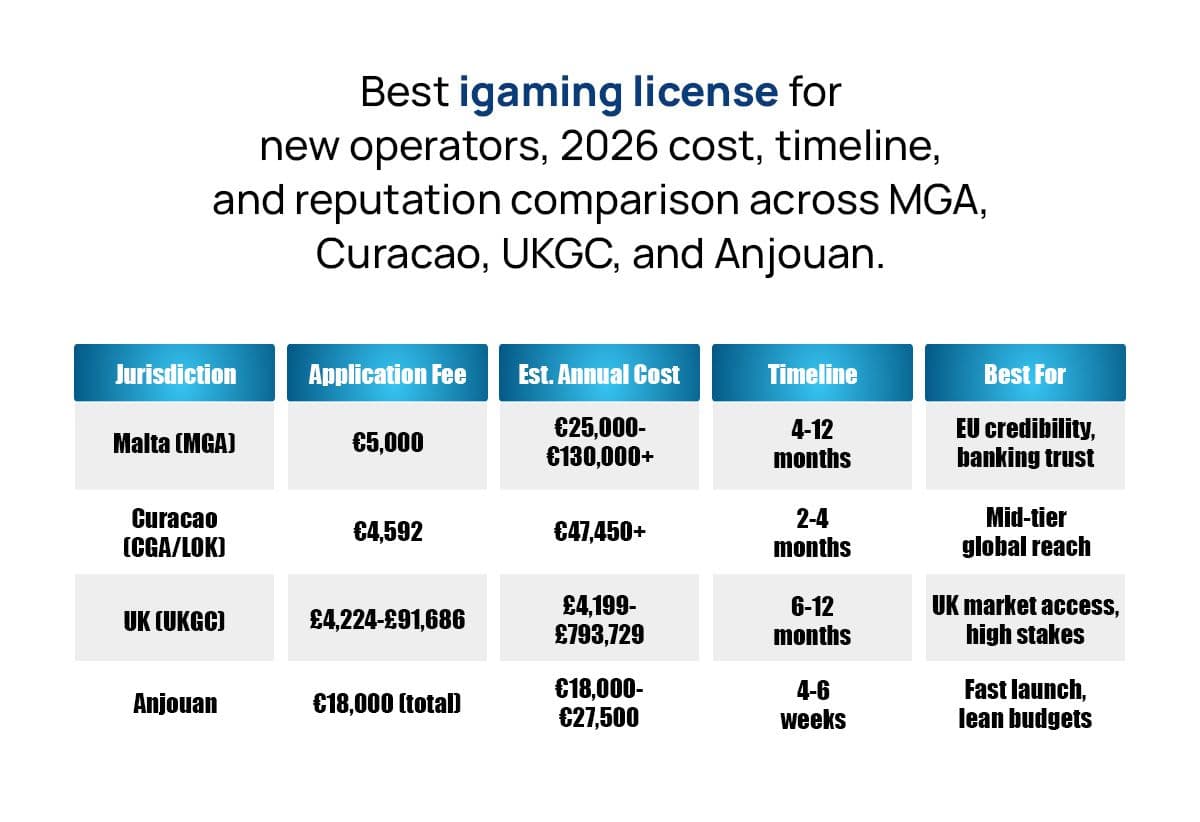
Curacao sits in between, offering faster approval than MGA but higher ongoing fees than Anjouan since its 2026 LOK reform.
Use this igaming license cost comparison as a starting shortlist, then confirm exact fees with SolveByte's regulatory and licensing consulting team before filing, since bands and enforcement dates shift throughout the year.
What Research Says About Regulatory Quality
A 2025 scoping review published in Harm Reduction Journal examined legal responses to online gaming harms and found that inadequate frameworks, not the presence of licensing itself, drive most negative outcomes, and recommended a "comprehensive regulatory package" so operators can't simply shop for the lightest-touch rules. For new operators, that's a signal: a cheap license without a credible compliance program invites exactly the scrutiny it was meant to avoid.
Conclusion
The right license depends on your target markets, runway, and compliance appetite, not just the sticker price. MGA and UKGC buy credibility in premium, heavily banked markets; Curacao and Anjouan buy speed and lower upfront cost, provided you can live with lighter-touch reputations. Whichever route fits your best igaming license for new operators shortlist, verify the current fee schedule directly with the regulator before filing, since 2026 has already brought major changes to all four jurisdictions.
If you're weighing an online gambling license application against a launch timeline, SolveByte's regulatory and licensing consulting team can map the fastest compliant path for your platform. Talk to us before you file a single document.