


Healthcare's most dangerous inefficiency is not misdiagnosis, it is lost information. A patient arrives at an emergency room, their allergy history is buried in a paper file across town, and a medication error follows. The EHR System was built precisely to end that gap. Yet most healthcare organizations still underutilize it.
This guide covers the full picture: what EHR software is, how it works, its standout features, and the evidence-backed advantages that make it indispensable for modern healthcare delivery.
What Is EHR Software?
EHR system, short for Electronic Health Record software, is a digital platform that captures, stores, manages, and shares a patient's complete medical history in real time across authorized healthcare settings. Unlike paper records, EHR software makes patient data accessible to physicians, specialists, labs, pharmacies, and insurers simultaneously, enabling coordinated, accurate, and faster care.
"EHR systems play a crucial role in improving healthcare efficiency, reducing costs, and enhancing patient care."
The global EHR market was valued at USD 32.44 billion in 2025 and is projected to reach USD 52.60 billion by 2034, growing at a CAGR of 5.61%. Cloud-based EHR software alone commands 83.68% of market share, reflecting rapid adoption across hospitals and outpatient clinics worldwide.
EHR vs. EMR: What Is the Difference?
A common source of confusion in healthcare IT is the distinction between EHR software and EMR (Electronic Medical Record) software. The difference is interoperability:
- EMR = a digital version of a patient's chart within a single practice
- EHR software = a comprehensive, shareable record that travels with the patient across providers, hospitals, and systems
In short, every EHR is an EMR, but not every EMR is an EHR. For healthcare organizations aiming for cross-facility coordination and regulatory compliance, EHR software is the clear standard. According to a 2022 qualitative study published in Sage Journals (PMC), clinicians who switched from siloed EMR systems to integrated EHR software reported measurable improvements in both healthcare quality and patient safety outcomes.
__
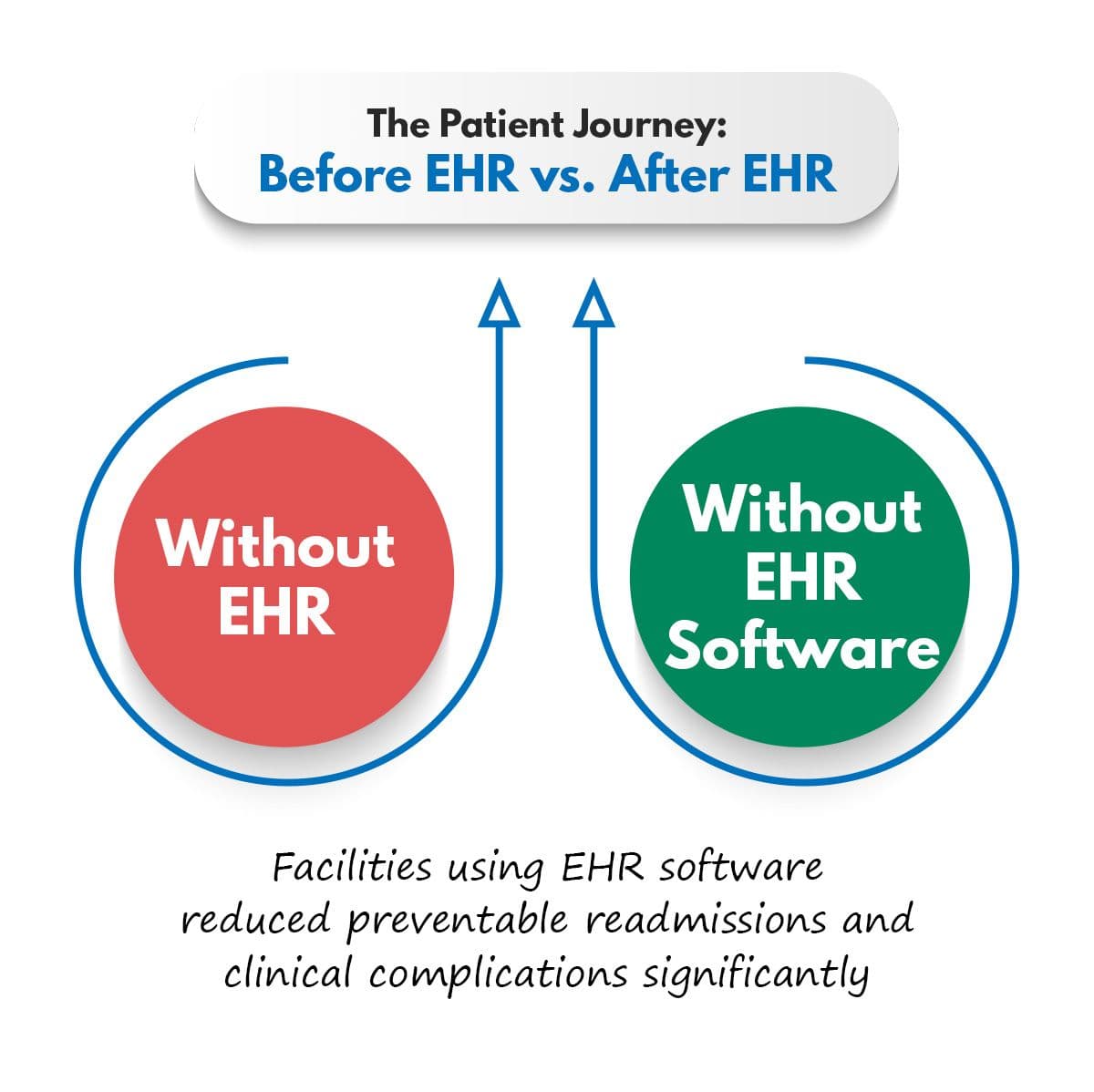
Without EHR
- Doctor manually calls pharmacy to check medication history
- Duplicate blood tests ordered (previous results unavailable)
- Billing team manually re-enters data from paper charts
- Specialist has no access to GP notes, starts from scratch
- Average admin time per patient: 50+ minutes
With EHR Software
- Allergy flag automatically surfaces at prescription stage
- Previous lab results visible, no duplicate tests
- Billing auto-coded from clinical notes
- Specialist sees full GP history instantly
- Average admin time per patient: Under 10 minutes
6 Core Features of EHR Software
Modern EHR software is far more than a digital filing cabinet. The best platforms include:
1. Centralized Patient Data Management
All clinical notes, lab results, imaging, medication lists, allergies, and visit histories are stored in a single, searchable record. This eliminates duplicate data entry and reduces the risk of clinical errors caused by incomplete information.
2. Clinical Decision Support (CDS)
EHR software surfaces real-time alerts, drug interaction warnings, dosage flags, and evidence-based care guidelines, directly at the point of care. A 2025 systematic review published in Sage Journals found that CDS tools embedded in EHR platforms significantly improved hospital efficiency and patient outcomes.
3. Interoperability & Data Exchange
Leading EHR systems comply with HL7 FHIR standards, enabling seamless data sharing between hospitals, clinics, pharmacies, and insurance providers. This interoperability is foundational for care coordination and reduces redundant testing, a key cost driver in Healthcare Management Software.
4. HIPAA-Compliant Security
Healthcare data breaches are among the most costly of any industry. Enterprise-grade EHR software incorporates role-based access controls, audit trails, end-to-end encryption, and full HIPAA compliance to protect sensitive patient information.
5. Telehealth Integration
Post-pandemic healthcare permanently elevated virtual care. Modern EHR for hospitals integrates telehealth workflows directly into the platform, so remote consultations, e-prescribing, and follow-ups are captured in the same Patient Record Management Software as in-person visits.
6. AI-Powered Documentation
AI-driven medical scribes embedded in next-generation EHR software can reduce after-hours documentation by up to two hours per day per physician, directly addressing clinician burnout, one of the sector's most pressing workforce challenges.
Proven Advantages of EHR Software
Fewer Medical Errors
Research published in NCBI/PubMed confirms that EHR systems reduce medication errors and duplicated tests by giving providers access to comprehensive, up-to-date patient information at the moment of decision.
Lower Operational Costs
By automating billing, coding, and administrative workflows, EHR system reduces overhead costs. North America, which holds 47.33% of the global EHR market, has seen the strongest ROI among early adopters, particularly in large hospital networks.
Improved Patient Outcomes
A landmark observational study modelled EHR's impact on mortality, readmissions, and complications. Facilities with mature EHR software implementations demonstrated statistically significant reductions in preventable readmissions and clinical complications.
Regulatory Compliance
From HIPAA in the U.S. to GDPR for patient data in Europe, EHR system helps healthcare providers meet compliance requirements automatically, logging every access event, generating audit reports, and enforcing data governance policies.
Better Continuity of Care
When a patient moves between a GP, a specialist, and a hospital, their complete electronic health records travel with them. Our Healthcare EHR Solutions continuity prevents dangerous information gaps and enables faster, better-informed treatment decisions.
The Future of EHR Software
The next frontier for EHR software is AI by design, not AI as an add-on. As reported by Healthcare IT Today, the defining question for EHR platforms in the coming years is not "does AI work?" but "can it run safely and consistently at enterprise scale?"
Predictive analytics, ambient clinical intelligence, and population health management will define the next generation of EHR software, and the healthcare organisations that adopt early will carry a lasting competitive advantage.
Conclusion
EHR software has moved from a regulatory obligation to a clinical and operational necessity. With a global market approaching USD 52 billion by 2034, backed by peer-reviewed evidence of improved outcomes and measurable cost reductions, the case for adoption is clear.
Whether you are a solo practitioner or a multi-facility health system, the right EHR software is the single most impactful digital investment you can make in patient care quality and practice efficiency.
Ready to modernize your practice? __Secure Now