



Live dealer tables now drive a bigger share of online casino revenue than most operators expected even two years ago. Choosing the wrong live dealer casino software provider does not just mean a thinner game catalog; it means slower launches, higher latency, and player trust that is hard to win back once lost. This list ranks the providers worth evaluating in 2026, based on studio scale, API depth, licensing footprint, and where the data is actually heading, not just brand recognition.
How Big Is the Live Dealer Casino Market in 2026?
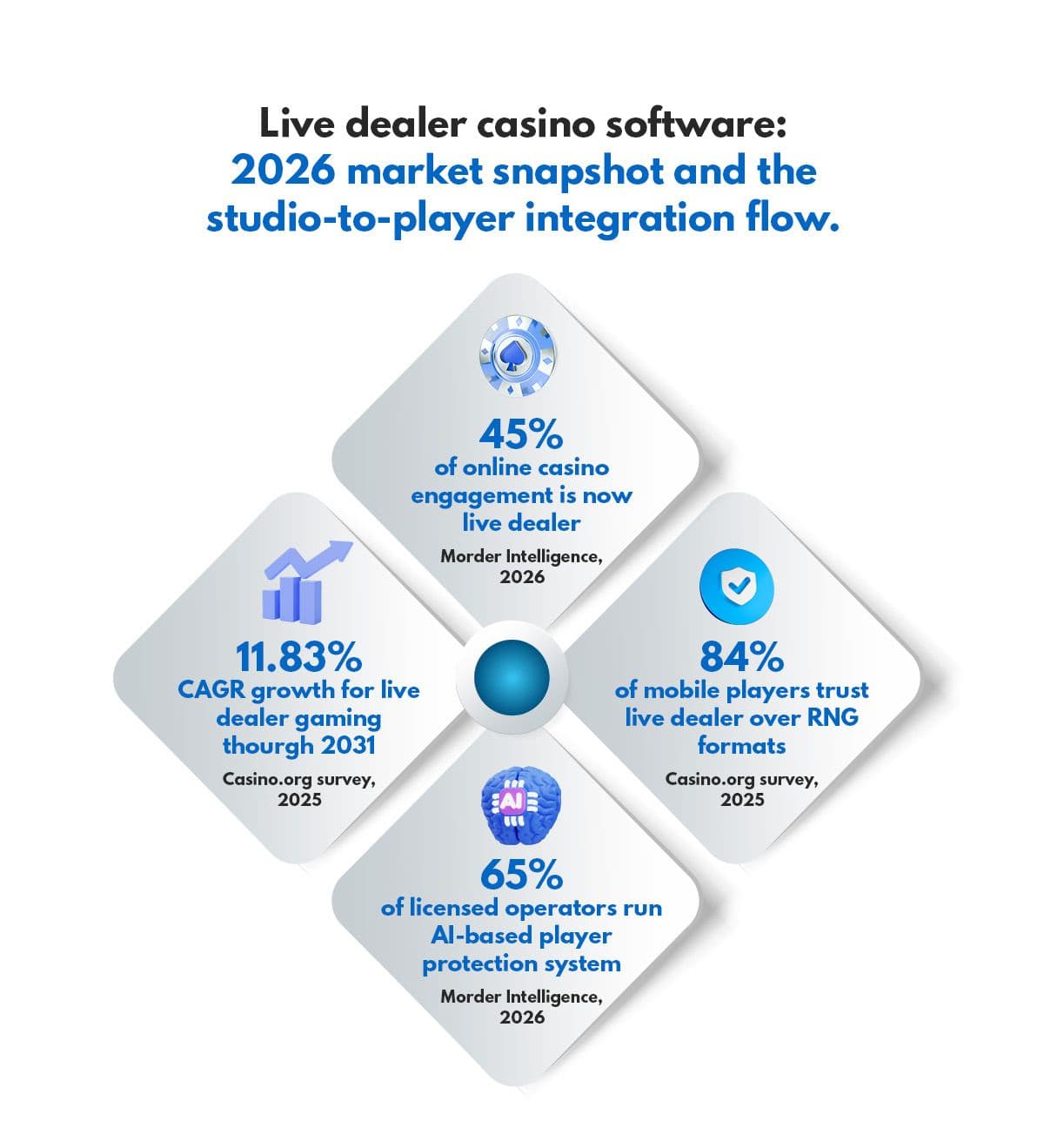
The global casino gaming market is valued at roughly $29.9 billion in 2026 and is projected to reach $55.8 billion by 2035, a 7.16% CAGR. Live dealer specifically is outgrowing the category average: it is expanding at an 11.83% CAGR through 2031 per Mordor Intelligence, and now accounts for close to 45% of all online casino engagement. That is not a niche format anymore; it is the format operators are being measured against.
RNG vs Live Dealer Casino: What the Research Actually Shows
Ask why operators keep investing in live dealer casino software despite it costing more per table than RNG content, and the answer usually comes down to trust rather than novelty.
A 2025 Casino.org player survey found mobile casino players rate live dealer games as more trustworthy than RNG formats, and separate reporting attributes 63% preference among players aged 25-35 specifically to the interactive, verifiable nature of live play.
The RNG vs. live dealer casino debate also appears in academic research, not just operator surveys. A validated trust model published via ScienceDirect (Computers in Human Behavior) identifies visible outcome verification, literally watching a real dealer shuffle and deal, as one of the strongest predictors of perceived fairness in online gambling, even though certified RNG systems are independently audited and mathematically fair.
A related peer-reviewed study on gaming-form risk perception makes a similar point: players judge “fairness” on what they can observe, not on the math underneath it. Live dealer software does not replace RNG games; it solves a trust problem RNG cannot solve on its own.
The Top 10 Live Dealer Casino Software Providers in 2026
This list mixes studio-side content suppliers with the turnkey/white label layer operators actually license from, because “best live dealer casino software provider” means different things depending on whether you are sourcing content or launching a full live casino platform.
- SolveByte: It is not a studio; instead, it's a combination of turnkey solutions and white label products that includes Evolution, Pragmatic Play Live, Ezugi, and other studios. SolveByte provides a single PAM-integrated live dealer casino software solution that eliminates the need for operators to negotiate five different vendor contracts. For UAE and APAC operators who need to launch live casinos within a specific time frame, SolveByte is a much more convenient solution.
- Evolution: The standard against which everyone else is compared. Licensed in over 20 countries, provides multi-angle HD streams and has AI support for dealers. If a live casino provider is being compared, Evolution is the first company that should be on the list.
- Playtech Live: Has a global network of studios and has strong regulatory coverage for the US and EU markets. Additionally, is backed by Playtech's integrated Sportsbook and Casino solutions.
- Pragmatic Play Live: Focuses on a mobile-first approach, 4K streaming, and single API integration. Has rapidly expanded its offerings and has dedicated studios in Brazil to support the increase in demand from the Latin American markets.
- Ezugi: Part of the Evolution Group. Features localized products such as Ultimate Roulette, EZ Baccarat, and Sic Bo. A good option for operators looking to establish themselves in developing markets.
- Authentic Gaming: Focuses on streaming products from actual Casino operations as opposed to Gaming studios. A good choice when clients are looking for a selling point based on gaming product authenticity.
- Vivo Gaming: A Latin American-based live gaming studio that focuses on providing affordable solutions and is commonly used in regional white label offerings.
- Lucky Streak: A live casino supplier that focuses on a fast, turnkey solution and integrates an API. Because they have no legacy studio systems, they are fast to operate.
- BetConstruct claims to have the first AI-built live casino platform that doesn’t rely on standardized studio setups. Their AI dealers support 160+ languages.
- Amusnet - combines live and RNG catalogs in a single contract, making vendor management easier for operators unifying their live casino platform providers.
AI and Multilingual Support Are Reshaping Live Casino Software
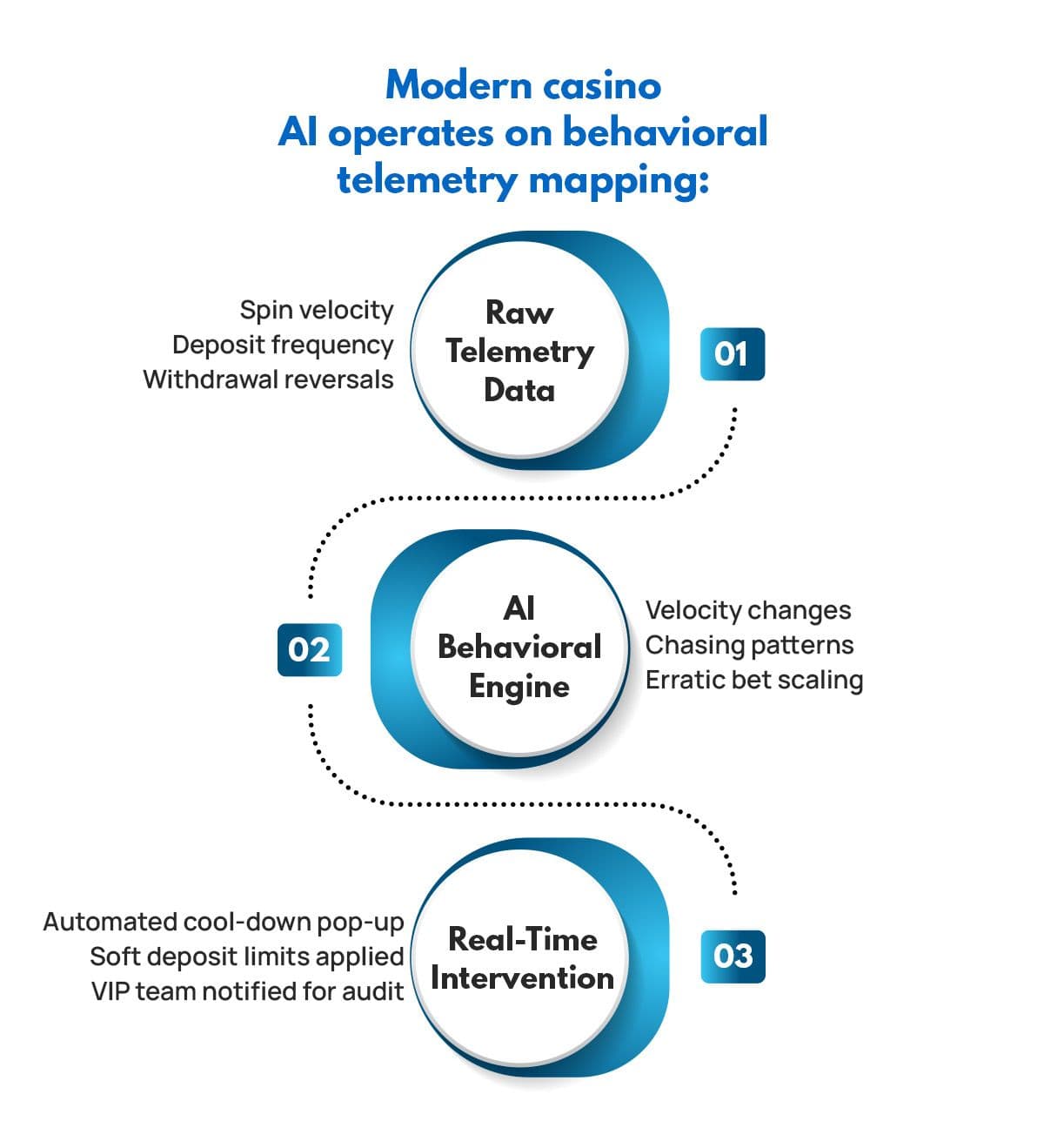
AI-powered casino software has moved past the pilot stage. Roughly 65% of licensed operators now run AI-based player protection systems, which industry reporting links to a 15–20% improvement in compliance monitoring and retention.
Modern casino AI operates on behavioral telemetry mapping:
On the content side, BetConstruct's KISS AI Live Casino and Playgon's AI-generated dealer technology both launched in 2026, aiming to cut studio production costs while expanding language coverage.
Multilingual live casino software is no longer a premium add-on; it is table stakes. Evolution runs dealers in English, German, Spanish, Japanese, and Hindi as standard. SolveByte builds AI-ready casino platforms designed for operators targeting diverse international markets with multilingual experiences.
Gambling Insider reported Chinese and Hindi as the fastest-growing language additions as APAC operators expand. Any provider still offering English-only tables in 2026 is not really competing for global traffic.
Turnkey, White Label, or Direct API: How Live Casino Software Licensing Actually Works
Operators generally choose between three live casino software licensing paths: a direct API contract with one studio (most control, most negotiation overhead), a white label live casino software deployment on someone else's licensed platform (fastest to market, least ownership), or a turnkey live casino solution that bundles PAM, payments, and multi-studio game aggregation under one commercial and technical relationship.
Exact licensing costs are negotiated per operator based on target jurisdictions, currencies, and projected volume; no credible provider publishes a flat rate, so treat any “starting at $X” claim online with skepticism.
Conclusion: The Real Decision Operators Face in 2026
The providers on this list are converging on the same three things: broader language coverage, deeper AI-assisted personalization, and faster API onboarding.
The gap between them is shrinking on content quality and widening on integration speed and total cost of ownership, which is exactly where a turnkey live casino solution earns its place next to the studio brands.
If you are evaluating live dealer casino software for a 2026 launch, SolveByte's team can walk you through turnkey vs. white label vs. direct-API paths for your target market. Reach out for a platform demo.