


The online gaming market sits at $120.35 billion in 2026. This is the guide that covers all of it, every step, every cost, every decision that actually matters.
Why 2026 Is the Year the Rules Changed for New Operators
Two forces collided in 2026 that simply did not exist three years ago, and together they have permanently reshaped what it means to start an online casino.
1. Regulation went global and got precise.
Europe holds over 41% of the global iGaming market and has rolled out pan-European "markers of harm" standards that every operator must embed into automated systems.
Australia banned credit card deposits for online gaming platforms entirely in 2024. A landmark 2024 study published in Addiction confirmed that behavioral compliance data from operators is now the primary indicator regulators use to assess player harm, meaning your data infrastructure is no longer just an IT concern; it is a licensing condition.
2. Online casino startup costs dropped dramatically.
A fully compliant, market-ready white label casino platform that once cost over a million dollars to build now launches for under $200,000. The barrier to entry has fallen, but the compliance bar has risen to match it.
The implication is clear: if you are planning to start an online casino business in 2026, getting licensed and getting compliant are not two separate workstreams. They are the same workstream.
What are the steps to start an Online Casino?
Launching an online casino may seem complex, but a simple step-by-step approach can help operators move forward with confidence.
Step 1: Pick Your Jurisdiction
Your online gaming business license determines your banking relationships, player trust, which payment processors will work with you, and the ceiling on your growth. Choose wrong here and every step after it gets harder.
| Jurisdiction | Cost (Year 1) | Timeline | Best For |
|---|---|---|---|
| Curaçao | $60,000-$100,000 | 2-4 months | Budget launch, emerging markets |
| Malta MGA | $150,000-$300,000 | 4-6 months | EU players, premium credibility |
| UKGC | $200,000-$500,000+ | 6-8 months | UK market access |
| Anjouan | $20,000-$50,000 | 1-3 months | Lowest cost entry |
Best information most guides typically don't include: Tier-1 licenses (MGA License, UKGC License) not only concern credibility, but they also unlock Tier-1 payment processors. Stripe, the major card networks, and most PSPs will not process gambling transactions from unlicensed jurisdictions. If you plan to serve European players at scale, expect a Curaçao gambling license to limit your conversion rates.
Step 2: Company Formation and Documentation
Register your company in the licensing jurisdiction with minimum share capital, local directors, and a registered office. Before any software is selected, you need these four documents in hand:
- A online casino business plan with 3 year Financial Projections
- AML KYC Procedures
- Responsible Gaming Policies
- Technical Gaming System and Security
A study from BMC Public Health 2024 found that online casino platforms deploying real-time player protection tools reduced harmful play patterns by up to 30%. Regulators have seen this research. Responsible gaming tools are now actively scored during license applications, not just checked as a box.
Step 3: Selecting a Platform: White Label, Turnkey, or Custom
This is the single most consequential technical decision in your online casino development journey. Get it wrong, and you are looking at $100,000-$300,000 to switch, plus up to 40% player attrition during migration.
White Label Casino Software: You operate under the provider's license and rebrand their platform. Setup costs $50K–$200K plus a revenue share of 15–40% of Gross Gaming Revenue. You can launch in 4–8 weeks. The tradeoff: you do not own the player data, and every product decision requires provider approval.
Turnkey Casino Software: You own the codebase, the license, and the player relationships. Full control over payment methods, market expansion, and product features. Launch timeline is 3–6 months at a cost of $100K–$400K, with no ongoing revenue share.
Custom Online Casino Development: Full proprietary build. CapEx starts at $500K, and the development timeline runs 12+ months. The right choice only for well-capitalised operators with a long-term vision and a specific technical requirement no existing platform can meet.
The migration strategy the industry uses but nobody publishes: Start on a white label casino platform to validate your market, build your player base, and generate real revenue. Once your monthly GGR covers the migration cost ($100K–$300K), move to a turnkey model. Migrating too early burns capital. Migrating too late means permanently handing 20–40% of your revenue to a provider.
Step 4: Customize Your Content and Control Your Payment Methods
Game Content
Partner with a game aggregator to access thousands of slots, live dealer tables, crash games, and virtual sports through a single API integration. Leading aggregators, including SoftSwiss, EveryMatrix, and Relax Gaming, also handle RNG certification on your behalf, removing a major technical compliance burden.
Payments: A compliant payment stack for 2026 incorporates the following:
Card processing (Generally requires a tier-1 license for Mastercard/Visa card processors)
eWallets (Skrill, Neteller, PayPal, and others, where applicable)
Crypto (Bitcoin and USDT — especially in emerging regulated markets with the MiCA framework post-2024)
Local methods: UPI (India), PIX (Brazil), iDEAL (Netherlands)
A 2025 study in the Journal of Gambling Studies revealed that players facing payment friction on deposit experience a significantly higher, 58%, churn rate within 30 days.
Step 5: Build Compliance Into the Product
The most common and expensive mistake first-time operators make is treating compliance as a legal workstream rather than a core product feature. By the time it is bolted on, it is already costing you in license risk, in player trust, and in operational overhead.
Your 2026 compliance infrastructure must include:
KYC/AML Automation: Real-time identity verification at registration and for all withdrawals above regulatory thresholds. Tools like Sumsub, iDenfy, and Comply Advantage handle this at scale.
Responsible Gaming Tools: Player-controlled deposit limits, loss limits, session time alerts, and self-exclusion linked to national registries (GAMSTOP in the UK, OASIS in Germany).
Behavioral Monitoring: Session tracking, velocity checks, and affordability assessments. Mandated by MGA, UKGC, and all Scandinavian regulators.
Data Sovereignty: Full GDPR compliance with player data stored within regulated EU infrastructure. Non-negotiable for EU-licensed operations.
A 2025 study from the National Institutes of Health (NIH/PMC) on platform design found that online casino platforms without transparent responsible gaming interfaces face significantly higher regulatory scrutiny and increased rates of license non-renewal. Compliance has become a genuine competitive advantage; players actively choose platforms they trust with their data and their limits.
Step 6: Execute Your Marketing Strategy
For most online casino businesses, 60-70% of first-time deposits come from affiliate marketing. This means that your affiliate program should be built before your site launches. 2026’s primary customer acquisition channels include:
Affiliate networks: Income Access, MyAffiliates, Cellxpert
Search Engine Optimization: Long-tail Keywords - "best casino with fast withdrawals", "[payment method] casino", etc.
Paid Social: Meta and Google enforce strict iGaming advertising policies. Submit creatives for approval and build geo-targeted compliance flows before spending a dollar.
Influencer/Streaming: Twitch and YouTube casino content drives extremely high-intent traffic in markets where this content is permitted. Vet creators for compliance before partnering.
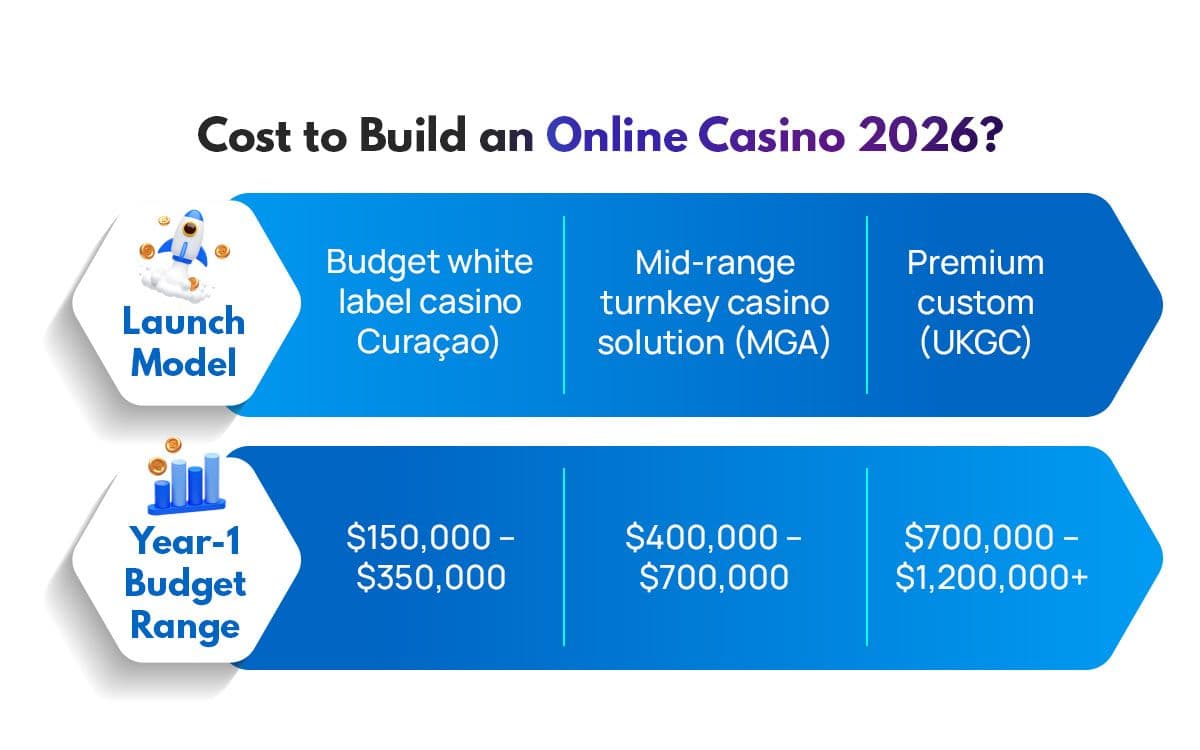
What Does It Actually Cost to Build an Online Casino 2026?
What’s the operator advantage?
The iGaming operators who build lasting businesses in 2026 share a single trait: they invest in responsible gaming technology not because regulators demand it, but because they understand it creates real commercial value.
Players who trust a platform stay longer. Players who trust a platform refer others. Players who trust a platform have a measurably higher lifetime value.
Conclusion
Building your online casino on a foundation of data-driven compliance, a jurisdiction matched to your actual target market, and a platform you genuinely own, whether through a turnkey or custom model, is not just the ethical approach. Based on all trends in 2026, it is the commercially superior option.