


If deliveries are late and you're getting "where's my order" asks, you probably have a visibility issue rather than a delivery problem. This guide will help you understand the delivery tracking system basics, from GPS API to courier assignment. It even helps you understand how much to realistically budget to build one in 2026.
What Is a Last-Mile Delivery Tracking Platform?
A Last-Mile Delivery Tracking System helps show the status of an order in the delivery process. It gives the user access to the order's GPS location in real-time, when it's expected to arrive, and even what proof is available of the order's drop-off. For plenty of companies that are still taking orders and doing deliveries via calls and the use of spreadsheets, this is the first significant and worthwhile upgrade, and it is the basis of everything that this guide talks about.
Its Role in Logistics Software Development
In the scope of logistics tracking software, it is the information module that every stakeholder and user of the system interacts with, and that's the reason why it's the first thing that teams build and/or improve.
How It Fits Into Fleet Management Software
Tracking information serves as the core of fleet management software to ensure that all journeys are tracked, the fleet's resources are maximized, and employees are evaluated based on the information being tracked.
Why Does Last-Mile Delivery Need Tracking?
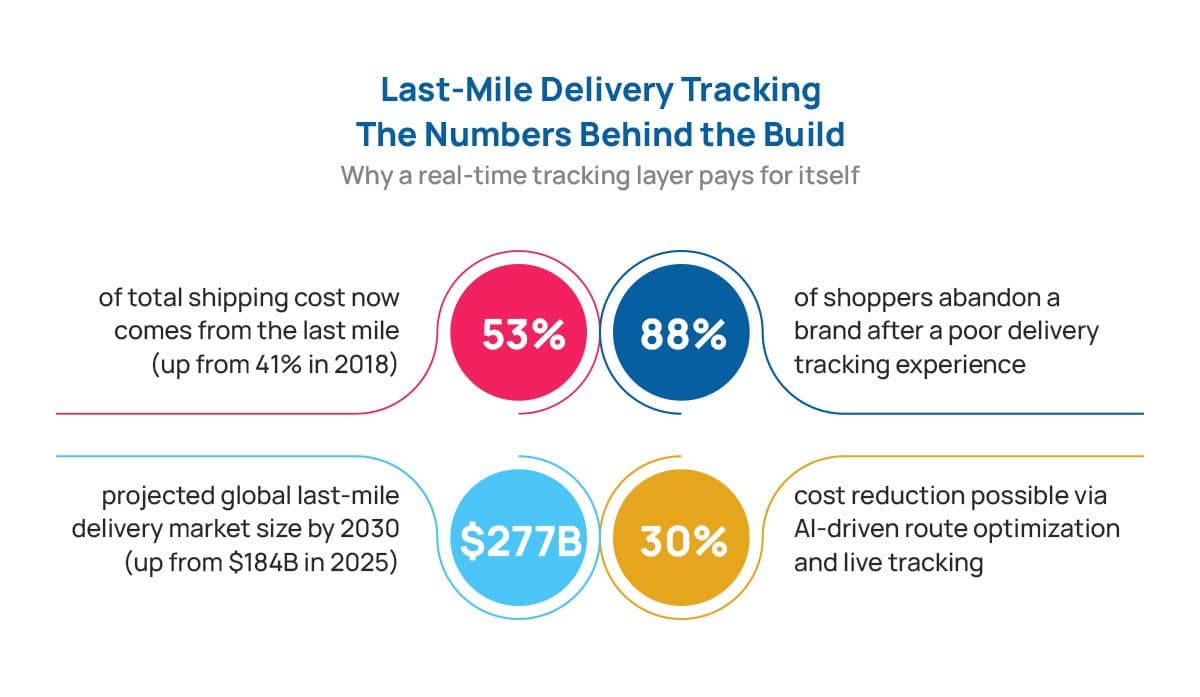
Last-mile delivery makes up 53% of the total shipping cost, and the delivery itself shows up on the customer's end in real-time. This is important to get right because 88% of consumers say they would stop buying from a company after one bad tracking experience.
Customer Experience and Delivery ETAs
With real-time ETAs, "where is my order" support tickets drop by 70%. This is because customers stop making guesses about order delivery and start watching it on its way.
Cost and Route Efficiency Gains
With real-time order tracking and route optimization, last-mile delivery solutions have been able to reduce costs and increase efficiency. This has resulted in a 28% drop in last-mile delivery costs by eliminating refund mileage caused by missed stops or undelivered stops.
What Features Should the Platform Include?
An effective platform should have five working components, rather than a single dashboard with a spreadsheet.
Real-Time GPS and Fleet Management Software
Vehicle tracking technology integrated with Fleet Management Systems. This should also include published studies on the impact of real-time GPS tracking of last-mile delivery on Fleet Management Systems and on the tracking of route history and utilization.
Route Optimization and Dispatch
Dynamic routing that reassigns stops in real time as traffic, cancellations, and new orders come in.
Courier Management Software Tools
Courier Management Systems for onboarding, shift assignment, and performance rating for gig or in-house drivers.
Customer Notifications and Delivery Management Software Features
SMS and push notifications with live tracking are the delivery management systems' core features that are now standard.
Proof of Delivery and Analytics Dashboard
Photo or digital signature collection at drop-off integrated with an analytics dashboard that tracks the on-time delivery rate and the exceptions.
Which APIs Power Last-Mile Delivery Tracking?
Last-mile delivery tracking systems are primarily powered by four categories of APIs.
Maps and Geolocation APIs
Geocoding, live tracking, and turn-by-turn navigation are handled by either Google Maps Platform or Mapbox.
SMS/Push Notification APIs
To send delivery notifications or to let a driver contact a customer, use either Twilio or Firebase Cloud Messaging.
Payment and Order Management APIs
To manage cash on delivery (COD) transactions and provide status updates for every order, use either Stripe or Razorpay.
Third-Party Courier Management Software Integrations
With ready-made connectors to courier management systems, such as Shiprocket or Locus, you will not have to create carrier logic from the very beginning.
How to Build a Delivery Tracking Platform
Creating a delivery tracking platform can be divided into five sequential steps.
Discovery and Requirement Mapping
Before beginning the coding process, you must account for the fleet size, delivery zones, and the systems you already have.
Choosing a Tech Stack for Logistics Software Development
In logistics software development, teams often use Node.js or Django on the backend, have PostgreSQL as a database, and use a message queue to facilitate live location updates.
Delivery App Development for Customers, Drivers, Dispatchers
Developing a delivery application means having customer tracking, driver navigation, and dispatcher control as three separate applications.
API Integration and Testing
Maps, notifications, and payment APIs are integrated and tested for load capability to account for the maximum expected volume for location updates.
Deployment and Scaling
Start with a single region and expand your infrastructure to accommodate new delivery regions and an increased volume of orders.
How to Decide: Build vs. Buy for Tracking?
This tends to relate more to your delivery fleet size and delivery tracking roadmap, as opposed to a direct budgetary concern.
When Custom Logistics Software is a Suitable Option
When running your own proprietary routing logic or having several businesses to manage, custom logistics software will be worthwhile once it is adapted for white-label use beyond what a standard template can provide.
When an Off-the-Shelf Tool Is Enough
For operations with a few hundred daily shipments, no more than a single-region operation, a licensed, off-the-shelf solution will suffice.
How Much Does a Tracking Platform Cost?
Costs vary based on scope, not on the number of users.
Cost by Feature Complexity
A GPS tracking MVP will cost significantly less than a solution requiring route optimization, predictive ETAs, and analytics.
Cost by Team Location and Engagement Model
Developing with a remote or near-shore team will generally cost 40-60% less than a full-time employee in the U.S. or Western Europe.
Ongoing Maintenance and API Costs
Plan for 15-20% of the initial build cost for annual maintenance, and budget for monthly costs for maps, SMS, and payment APIs.
How Long Does Development Actually Take?
The duration of a project depends primarily on scope, not on the number of team members.
MVP Timeline vs. Full Logistics Platform Development
The typical duration for a tracking MVP is 8-12 weeks. A full logistics platform with route optimization and analytics can take 4-6 months.
Bottom Line: Choosing the Right Development Partner
On any platform, the primary function remains the same: solving the issue of "Where is my order?" with a number the operations team can use to answer the customer before being asked. We've helped B2B logistics teams scope and ship exactly this kind of logistics platform development, from a first tracking MVP to fully custom fleet systems. Talk to us before you lock in a budget.