


Losing a single deployment window at a sportsbook during the World Cup can be the equivalent of a sportsbook’s entire tooling budget for the year.
This blog breaks down the DevOps tools for iGaming that describe the challenges of maintaining sportsbook and casino real-money iGaming platforms online and compliant and safe under betting load, and the numbers behind it.
This blog also reflects a few of the more common mistakes made by operators, where they go wrong in the implementation of DevOps, and how we at SolveByte design around that gap.
Each major kickoff, tip-off, or jackpot spin creates a surge of simultaneous wagers placed at sportsbooks or casino platforms, and the infrastructure either will or won't support it. There is no retry for a real-money wager.
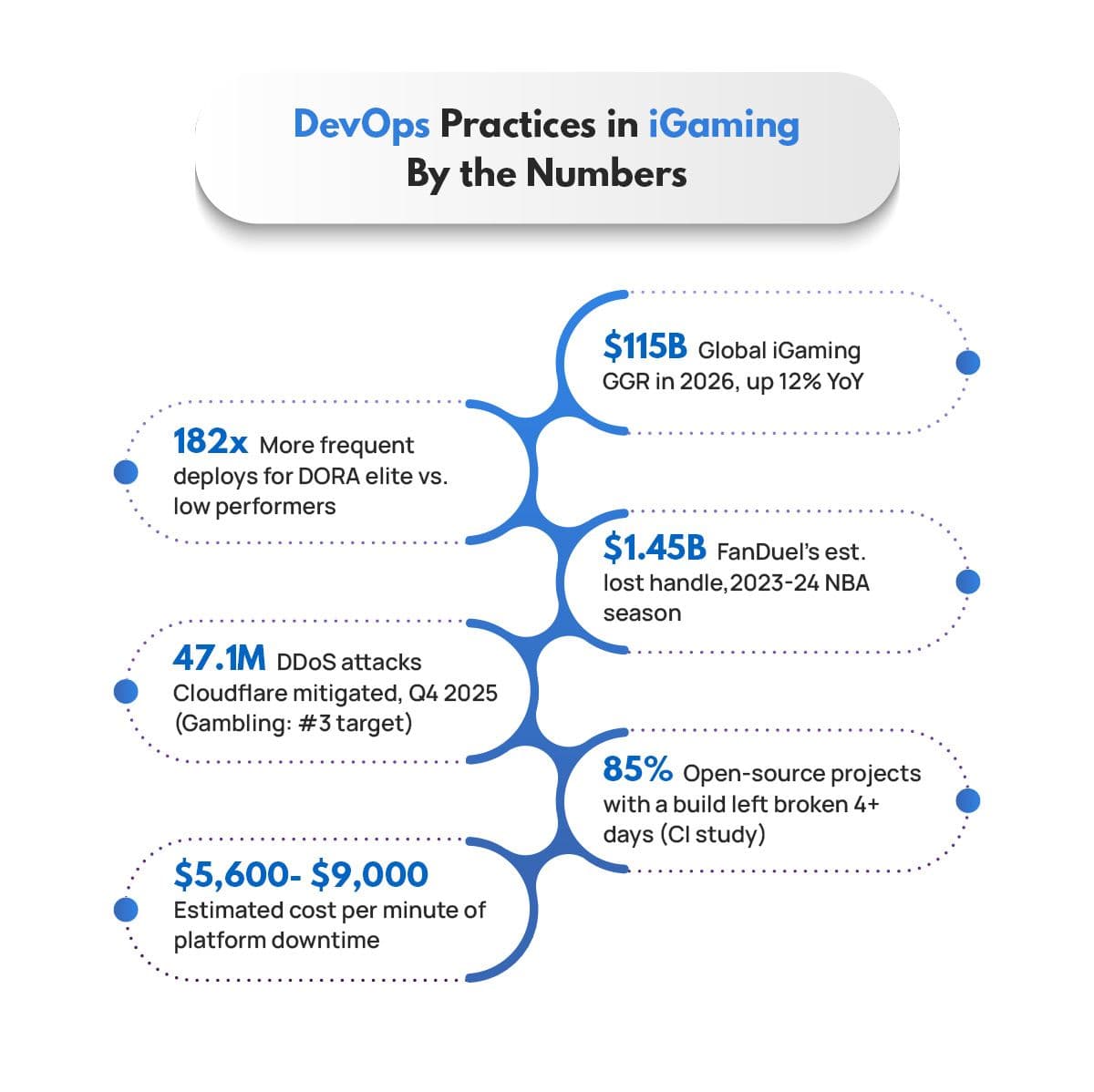
With the Global iGaming market grossing $115 billion in 2026 (a 12% increase from the previous year) and sportsbooks being the fastest-growing vertical (up 14% year-on-year), the stakes for getting reliability wrong increase rather than decrease.
That's why DevOps practices in iGaming have shifted from backend luxuries to requirements for licensing. Regulatory agencies now require platforms to demonstrate, rather than claim, their uptime, auditability, and rollback safety.
This blog outlines the methods and practices, with supporting data and research, showing how we at SolveByte build this.
What Are DevOps Practices in iGaming?
DevOps Practices in iGaming help casino, sportsbook, and platform teams integrate and combine engineering and tooling practices, allowing teams to safely deploy code.
This is done under real-time, real-money loads.
There are no separate checklists.
This means that combined practices of Infrastructure as Code, continuous integration and deployment, observability, and DevSecOps are working together.
How Does It Work?
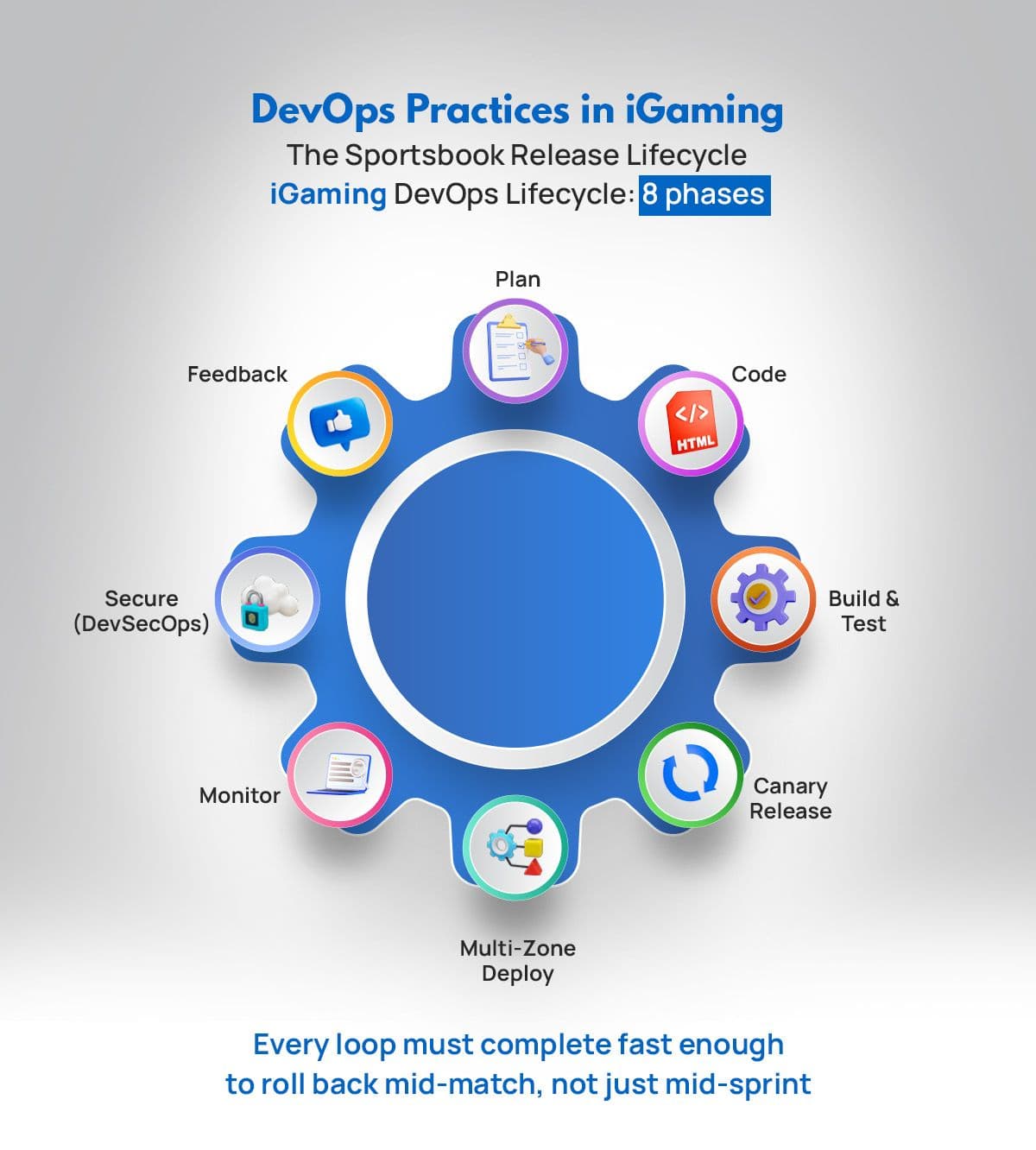
The beginning phases of DevOps software development involve these same standard software development phases: planning, coding, building, and testing. After these phases, development shifts into the specialized operations for financial platforms. These involve canary releases to update a limited group of users, as well as multi-zone deployments to meet the various local gambling laws.
The continuous monitoring of the infrastructure creates a channel for integrated security (DevSecOps) that protects the transactions and creates feedback loops for the next planning phase. As the caption indicates, the system has to work fast enough to perform a complete rollback of the software mid-match on a live betting event and not simply conduct the operations within the regular development sprints.
Why iGaming DevOps Practices in iGaming Differ From SaaS DevOps
The average SaaS rollback is to fix a bug. In the case of DevOps for iGaming, a sportsbook rollback during a match would have to undo (or safely fulfill) the wagers placed immediately before the system failure.
Based on downtime surveys aggregated by Atlassian, the average cost of a system failure for the companies is between $5,600 and $9,000 a minute. For a system that is processing live, real-money wagers, that is the minimum potential cost.
This single constraint is the reason why DevOps Practices in iGaming have greater regulatory and financial implications than DevOps in almost all other software industries.
Best DevOps tools used in iGaming platforms
Tooling choices differ by operator, but sportsbook and casino platform teams often gravitate toward similar categories.
Based on SBC News' coverage of the 2026 SBC Summit and the engineering track, infrastructure providers such as AWS, Google Cloud, and Cloudflare had entire conference sub-tracks dedicated to this stack.
This shows that platform engineering has risen to a significant level of interest in iGaming, beyond IT-related concerns.
CI/CD and Release Tools
To get code through automated testing and canary releases, Jenkins, GitLab CI, and Argo Rollouts are used. In the case of a broken odds feed, a small slice of traffic is impacted first, before the code is released to the entire player base.
Infrastructure and Container Tools
Terraform and Kubernetes help distribute workloads, reduce latencies, and increase resource availability at different datacenter locations with infrastructure as code. This prevents complete platform failures due to outages in isolated datacenter locations.
Monitoring and Observability Tools
The combination of Prometheus, Grafana, and ELK-style logging allows users to test the latency and error rates of APIs. It also tests the accuracy of odds feeds, all in real time and in a matter of seconds, as opposed to waiting for time-consuming daily reports.
Security and Compliance Tools
Vault, SonarQube, and compliance scanners automate check integration for encryption and access control. These are especially important for iGaming.
According to Cloudflare’s Q4 2025 DDoS Threat report, the Gambling and Casinos industries, as well as Gaming, are ranked the third and fourth most attacked industries and verticals, respectively, in a quarter during which Cloudflare mitigated 47.1 million DDoS attacks globally, a 121% year-on-year increase.
A security gate that lives inside a pipeline will catch licensing issues or exposed endpoints before a regulator or attacker does.
What are the core DevOps principles for high-availability igaming platforms?
Tools and technology will change, but the core principles that support high-availability iGaming platforms tend to remain consistent.
Automation-First Deployment
From real-world data conducted from DORA research, High-performing engineering teams deploy on-demand at a drastically higher frequency and experience a significantly lower change failure rate. Also, they recover from failed changes within a drastically shorter time frame.
Only an estimated 19% of teams in the DORA study are in the elite tier, a tier that is extremely important for sports betting applications to have.
Infrastructure as Code
Because environments are defined in code and managed in a version control system, disaster recovery becomes a real, repeatable test instead of a recovery plan everyone ignores.
Multi-Zone Redundancy and Failover
Traffic is distributed across regions and availability zones so that outages in one zone do not affect the entire sportsbook, even in the case of an outage during a live match.
Continuous Monitoring and Feedback Loops
Core Challenges iGaming companies face without DevOps
Without the use of DevOps Practices in iGaming, your system will most commonly exhibit the following system failure modes during the peak traffic times that any operator will wish to avoid.
The Revenue Cost of Slow, Manual Releases
This is going to be painful, both economically and competitively, for anyone not using DevOps Practices in iGaming.
- Bettormetrics, a betting-data analytics firm, conducted a study on the three largest US sportsbooks; their analysis shows that the in-game betting market used by FanDuel experienced an 83% suspension rate, resulting in a handle of $1.45 billion and a loss of $116 million in wagering.
- In contrast, the betting market used by DraftKings experienced a 4% suspension rate, resulting in a handle loss of $249 million and a loss of $18 million in wagers.
- The suspension rate differential (4% vs. 15%) is a problem that straddles both trading and systems and processes, and is a type of problem that latency, process automation and quicker release cycles are built to solve.
Regulatory and Compliance Exposure
This isn't speculative. In 2025, the UK Gambling Commission fined the Betfred operator £240,000 when online slot features violated their Remote Technical Standards.
- These violations should have been identified and corrected before the release reached players.
- Licensing authorities in the MGA, UKGC, and Curacao markets require online gaming operators to implement auditable patch cycles and configurable rollback, rather than just documenting compliance; this makes DevOps Practices in iGaming crucial and not just a temporary solution.
The "DevOps Theater" Risk in Real-Money Platforms
Continuous integration in iGaming is similar to what researchers have described in other fields as "CI theater", where a CI pipeline exists for the sole purpose of passing a badge check and is devoid of gates that add significance to CI.
- A peer-reviewed study that analyzed 1,270 open-source projects utilizing TravisCI discovered that the majority of these projects suffered from infrequent commits.
- The study also mentioned the average code coverage was at 78%, but the coverage for some projects was as low as 4%, and 85% of these projects had at least one build that remained broken for over four days.
In SaaS, a broken build that sits for four days is a nuisance.
In a sportsbook, a failure to roll back a deployment during a live match is a financial and compliance disaster, because a live wager cannot be undone.
How Do SolveByte DevOps Services Help?
We aim for the upper tier of the DORA benchmarks rather than the average levels found in the industry. Our method includes 8 sportsbook release steps that strengthen DevOps Practices in iGaming.
Platform Engineering Built Into Every Deployment
Like all other components of our system, our Player Account Management (PAM) and iGaming API integrations flow through the same automated deployment pipeline. Zero-downtime deployment is our default policy, not an additional service.
Compliance-Ready Releases Across Jurisdictions
No matter what type of sportsbook an operator runs, be it a fully custom build or a white label sportsbook, our process includes automated regression testing. Our process also includes compliance checks and staged rollouts as per MGA, UKGC, and Curaçao regulations before the releases are exposed to live traffic.
Multi-Zone Redundancy and 24/7 Monitoring
Through Multi-zone redundancy and 24/7 monitoring, a regional outage will not transform into a platform-wide outage, and audit trails will stand if a regulator requests one.
Bottom Line
DevOps practices in iGaming are the critical infrastructure that ensures a platform does not lose traffic during peak times. Leading operators consider CI/CD, DevSecOps, and observability to be their product, while the rest consider these practices to be just IT concerns. If you are not sure if your sportsbook or casino platform can revert a deployment mid-match, schedule a demo with SolveByte and we will show you what changes we would prioritize.