


The most difficult part of opening a new casino used to be selecting the content. Now it's about who's in the middle of your lobby and how quickly you can replace them as player behavior changes. The Global Online Gambling Market is expected to reach $143.17 billion in 2026, up 10% from last year, according to The Business Research Company. This article will focus on the most notable online casino game providers, what they excel at, and how to appropriately pair them to your market as opposed to conventional wisdom.
What Separates the Best Online Casino Software Companies in 2026
Certification, Not Catalogue Size
A large catalog of 5,000 games is worthless if only 2,000 of them are certified where your license is valid. Request the game list and certification matrix from Popular casino games for each market before signing on the dotted line. Just because a game is popular in Europe does not mean it will be certified and approved to launch in Ontario or a Curacao-facing Crypto brand.
Commercial Terms and Integration Effort
Online casino game providers offer a wide range of commercial terms**,** from revenue share and minimum guarantees to jackpot contributions and support for bonus tools. Along with the varying commercial terms, the effort required to integrate each provider is also very different.
The Timeline Nobody Publishes
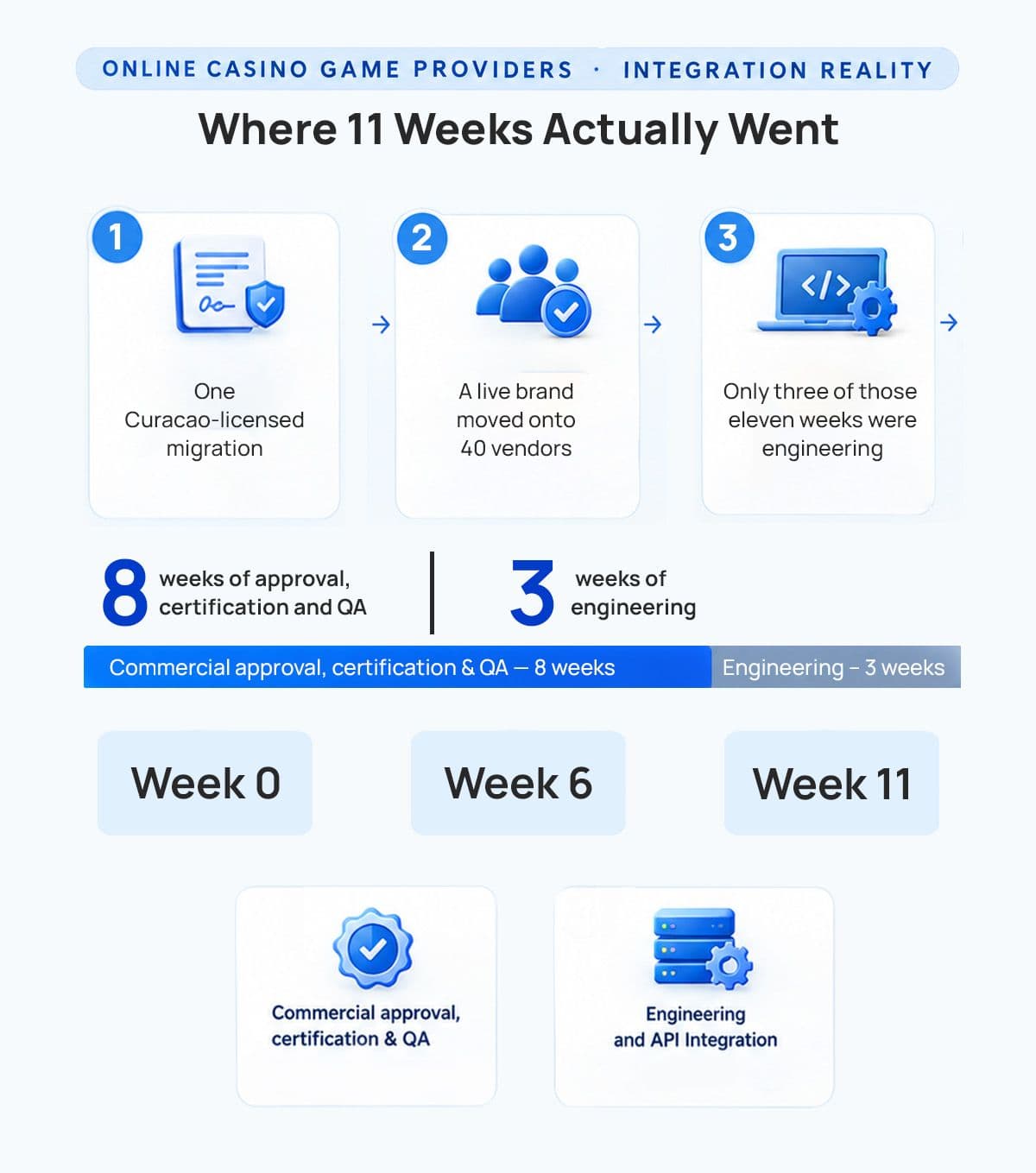
In our integrations, the API is rarely the bottleneck. Commercial approval and per-jurisdiction certifications add two to five weeks for each studio. During the migration of one Curacao-licensed casino, it took 11 weeks to move a live brand onto 40 vendors; three of the 11 weeks were dedicated to engineering.
Across our integrations, the pattern holds. Certification and commercial approval, not engineering, decide when your lobby actually goes live.
Top 10 Online Casino Game Providers in 2026
We have deliberately created our list by portfolio type, rather than quality. This way, we can ensure that each entry uses the same criteria for evaluation.
1. SolveByte, Custom Platform With Pre-Integrated Content
Founded 2024, Indore, India. 20,000+ games via 70+ certified providers.
They build the platform layer, PAM, wallet and bonus engine, and integrate vendor content, with KYC and AML flows mapped across 50+ jurisdictions.
Best for: online casino software for operators who want to own their software, rather than rent a lobby.
2. Pragmatic Play, Multi-Vertical Breadth
Founded 2015, Malta. 974 titles listed on SlotCatalog.
One of the few top casino game providers covering slots, live casino, bingo, and virtual sports from a single integration.
Best for: single-vendor coverage across verticals.
3. Evolution, Live Dealer Depth
Founded 2006, Stockholm. Live casino and game shows.
The go-to option for live tables and branded studios, with dedicated environments once volume justifies it.
Best for: brands where live tables are key to retention.
4. Playtech, Regulated-Market Infrastructure
Founded 1999, Isle of Man. Slots, live, bingo and platform.
They are listed, audited, and long established in regulated markets, which allows compliance teams to expedite their review among online casino game providers.
Best for: licensed operators in established markets of Europe and North America.
5. Play'n GO, Slot Mechanics Discipline
Founded 1997, Vaxjo, Sweden. 528 titles listed on SlotCatalog.
A disciplined approach to the release of slot games, which are built to maintain a lobby position for multiple years as opposed to a few weeks.
Best for: Operators looking to build a persistent slot core.
6. Games Global, Library Scale
Established in 2022 following the spin-out of Microgaming's content business in the Isle of Man. One of the largest licensed content collections.
Bundles multiple game studios under a single contract, thereby reducing the number of suppliers you work with.
Best for: Quickly populating a large gaming lobby.
7. BGaming, Crypto-Ready Delivery
Founded 2018. 383 titles listed on SlotCatalog.
Offers provably fair casino games and support for multiple currencies, and is focused on releasing games tailored for the needs of crypto and sweepstakes platforms.
Best for: crypto casinos and casinos without fiat currency.
8. Hacksaw Gaming, High-Volatility Hits
Founded 2018, Malta. 304 titles listed on SlotCatalog.
Offers scratch cards and short, high-volatility slot games that are well-suited for audiences with a preference for comparatively high entertainment value.
Best for: player acquisition with a focus on audiences below the age of 25.
9. Nolimit City, Mechanics-Led Differentiation
Founded 2013, Malta. 149 titles listed on SlotCatalog.
A small, deliberately so, volume catalog of extreme-volatility games with atypical art design and strong brand recognition.
Best for: differentiating your lobby from your competitors.
10. PG Soft, Mobile-First APAC Reach
Founded 2015, Malta. HTML5 slots built mobile-first.
Top casino game providers for the mid-range Androids, with casino game releases targeted at South and Southeast Asia.
Best for: Mobile-dominant APAC brands.
How to Choose Between Online Casino Software Companies
Match the Vendor to the Market
From your license, your payment mix, and your top three traffic sources, start here. Just because a studio ranks first on a list of the Top 10 Online Casino Game Providers, doesn't mean they're a good fit for you if they're uncertified in your market or if their bonus tools don't fit your CRM. Always check studio certifications, then commercial terms, then content.
Aggregation or Direct Integration
Vendors that you have approved directly give you better commercial terms. casino game Aggregation enables you to go live faster with the long tail. The majority of the brands we launch end up with a hybrid model: five to eight direct integrations, and the rest are done through an aggregator.
Final Take
The best online casino software is the one that allows you to be the most flexible; starting an online casino in 2026 is easier than ever. Popular casino games that you integrate will age, and the vendors that were essential to you in 2024 will probably not be in the same position two years later. Always build with flexibility, and swap out your online casino game providers every two quarters.
Book a demo with SolveByte to stress test your vendor mix and integration roadmap.