


Sasa tuko katika enzi ambapo matumizi ya AI katika ukuzaji wa sloti yamehamia kutoka dhana hadi utekelezaji wa kawaida.
Mwongozo huu unachambua jinsi na wapi AI inavyojumuishwa katika ukuzaji wa kisasa, kutoka tabia ya msingi ya mchezo hadi ubinafsishaji. Pia tunazingatia jinsi kipengele cha binadamu bado kinavyoendesha maamuzi muhimu ya ukuzaji, na hii ina maana gani kwa mshirika wako wa maudhui.
Utangulizi
Kwa sehemu kubwa ya historia ya sekta, kubuni sloti kulihusisha mtaalamu wa hisabati ambaye angeweza kuchora curve ya volatility. Kulihusisha msanii ambaye angeweza kukusanyia mandhari na timu ambayo ilitumia wiki kadhaa kuendesha spin za sloti kwa njia isiyokuwa na tija, inayochukua muda mwingi. Kwa bahati nzuri, siku hizo zimekwisha.
Leo, AI katika ukuzaji wa michezo ya sloti inabadilisha kwa kutabirika kila kipengele cha kipindi cha utengenezaji wa mashine ya sloti ya kisasa. Katika kila hatua ya uzalishaji wa studio, kutoka ubunifu wa awali wa mchezo hadi kazi za sanaa na programu ya mwisho, AI inabadilisha jinsi watengenezaji wanavyoona, kubuni, na kujenga mashine ya sloti. Mashine za sloti zinazotumia AI zinakuwa haraka kiwango kipya cha sekta, na kusababisha mabadiliko kutoka mashine za sloti za zamani za mitambo hadi mashine za programu, zinazobadilika, na zilizojumuishwa.
Mwongozo huu unaelezea maendeleo ya jinsi studio maalum zinavyobuni na kutengeneza mashine za sloti na kutabiri hatua gani teknolojia itafikia. Kulingana na EVP wa Bragg Gaming wa AI na Ubunifu, utekelezaji wa ubinafsishaji kwa AI utasababisha ongezeko la 30-50% la ushiriki wa wachezaji, na ifikapo 2026, AI itakuwa ya msingi kwa uendeshaji wa iGaming kama malipo salama.
Je, AI Ina Jukumu Gani Katika Ubunifu wa Mashine za Sloti?
AI haitumiki kubuni mchezo kutoka mwanzo. Badala yake, AI hutumika kupunguza umbali kati ya wazo na ubunifu. Wakati watengenezaji walitumia hisia zao kuongoza ubunifu wa mchezo, AI sasa inabuni michezo kwa kutumia data za mchezaji za wakati halisi na kujenga michezo kutoka kwa AI inavyotabiri kuwa bora kwa mchezaji. AI ya ubunifu ni mabadiliko ya mfano, kisha jenga.
From Intuition-Led Art to Data-Led Design
Rather than relying on instincts, teams rely on data to find out which player segments engaged, when they disengaged, and what retained their focus the longest.
Where Machine Learning Fits Into the Studio Workflow
Machine learning in casino games gets used in three places: the math model, the art pipeline, and the live operations layer. Each of these steps feeds the next, which is why the AI-slot game design process needs to be thought of in the end-to-end sense, as opposed to design changes post-launch.
How Does the AI Slot Design Process Work?
This is the actual process of AI-enabled slot design and the steps modern studios take, from data modeling and math to art generation, testing, and live personalization
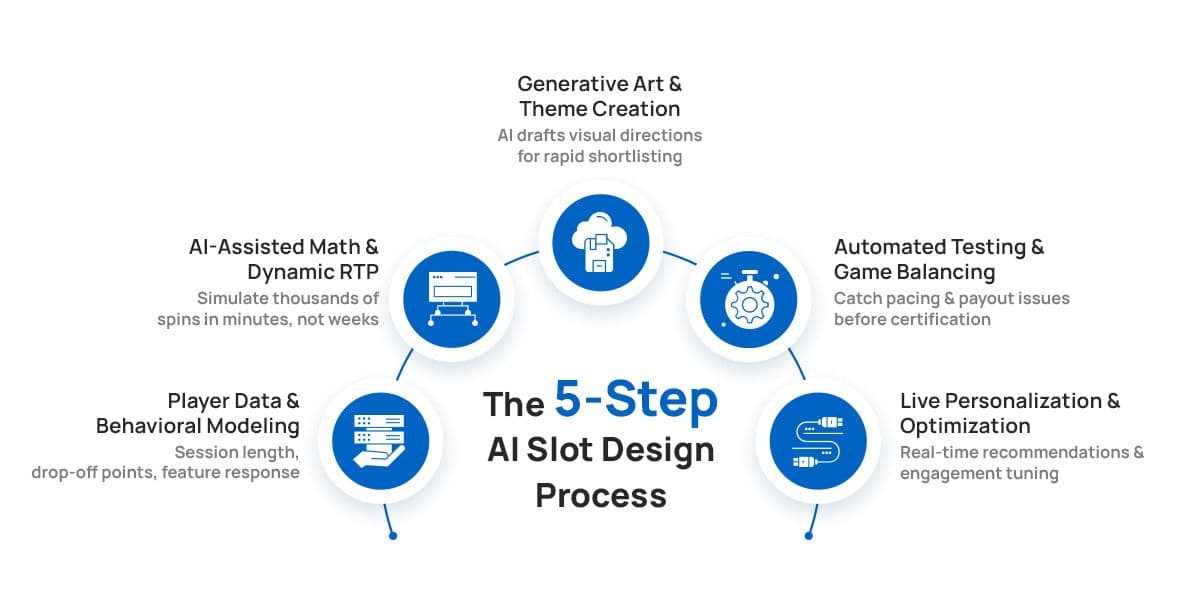
The process of AI slot design consists of five major steps, starting from modeling behaviors to live optimizations. If any of the steps in this process are missing, it leads to poor retention numbers.
Step 1: Player Data and Behavioral Modeling
Before the math or the art teams start working, player data modeling is undertaken. This focuses on player segmentation based on drop-off behavior and responsiveness to in-game features, as well as session length. This helps determine player engagement and what the segment is interested in.
Step 2: AI-Assisted Math and Dynamic RTP Design
Utilizing techniques pioneered by AI, math teams can simulate slot games in a fraction of the time previously required. Rather than taking weeks, it takes a fraction of a day to simulate thousands of spins and test paylines, bonus event triggers, and payout curves against target player segments. AI has made a huge impact on slot machine design by dramatically reducing the time it takes to model different design cycles.
Step 3: Generative Art and Theme Creation
When it comes to game art, generative AI game art enables studios to draft numerous art directions for symbols, backgrounds, and animations. This way, creative leads can select the most appealing concepts from multiple options instead of relying on their early intuitive judgments. This is an example of using procedural content generation and AI art for slot game theme development. It drastically shortens the theme development time from weeks to days.
Step 4: Automated Testing and Game Balancing
The use of AI to simulate gameplay in a slot machine significantly decreases the number of iterations of QA. The AI runs thousands of spins to identify balancing issues and other issues related to the pacing of animations and features. This is the AI's contribution to slot machine design as it reduces the time and the cost per title while ensuring quality.
Step 5: Live Personalization and Optimization
Once the slot machine goes live, AI personalization tools for casinos are used to optimize game design by tracking engagement, adjusting game recommendations and the timing of promotions, and pacing the game. This is how AI slot game art generation machines personalize the gaming experience after it has been launched.
Why Does Dynamic RTP Matter for Operators?
Dynamic RTP slots mean that a single game can alter its payout range rather than artificially limiting it to a single value. This is one of the main reasons AI-enhanced slots are beating static slots when it comes to player retention algorithms, as it vastly improves the experience of the player. Operators that don't employ AI to personalize slots for their players will lose engagement to those that do.
Balancing Retention With Compliance
Establishing player retention alone is meaningless if the RTP range certified by a regulator is exceeded. Within the regulator-certified RTP band, players and the pace of the game are personalized. The AI does not and should not modulate the random number generator (RNG) or certified payouts. That's why compliance guardrails should be designed into dynamic RTP slots to protect the edges of the band, and not added after the design stage.
What Risks Come With AI-Driven Slot Design?
The same power that makes AI-enhanced slots more engaging can drive higher engagement of vulnerable players towards more harmful behavior. The 2025 MDPI study, “AI Personalization and Its Influence on Online Gamblers’ Behavior,” set out to examine this phenomenon. It illustrates the effect of personalization on user behavior in igaming both positively and negatively. This is to demonstrate that the effect of AI on slot machine design is significantly faster than most regulation and compliance frameworks.
Why Human Oversight Still Matters
The reason the top studios include human oversight with every personalization model is because of responsible-gambling guardrails. Things like art direction can be recognized by AI. But AI shouldn’t determine what is shipped to a disengaging player, what is sent to a player at risk of developing a gambling addiction, or what is sent to a player at risk of committing a crime. AI in slot game development is not an exception to that rule.
How Can Studios Prepare for What Comes Next?
The future of slot machine technology is not one single AI tool. It will likely be an integrated AI pipeline where personalization, data modeling, and generative art all work together. Studios that adopt AI-based slot game development significantly ahead of the curve are likely to retain customers, and studios that implement AI-based slot game development as a peripheral add-on will likely continue to lose customers.
SolveByte designs turnkey and white-label iGaming platforms at SolveByte with an AI-focused architecture. Operators can develop personalized and behaviorally targeted content and design without the need to restructure their platforms every time a new AI capability is introduced. Feel free to reach out if you want to discuss how the design of slot machines is being transformed by AI.
Conclusion
AI modifies every part of slot design: the math models, art pipelines, and QA. AI also modifies how slot games personalize the experience based on player data. These changes do not eliminate the importance of human judgment. The distance from idea to validated build is drastically reduced, with human judgment remaining the same.
AI doesn't alter the math or Random Number Generators (RNGs). For AI slot game design process, follow the step-by-step guide.
The guide advises using an AI model built with data, and to personalize slots responsibly and never skip the human review at the end. This guide is the best place to start for operators and studios that treat AI as a singular feature rather than a slot game design pipeline.