


Every virtual care product needs a HIPAA-compliant telemedicine platform before its first patient logs in. This blog covers the various components of a HIPAA-compliant build, including architectural design, encryption, and access controls. It also discusses options for custom builds versus vendor products so one can manage their clinical workflow and budget.
The majority of large healthcare data breaches are caused by simple oversights, e.g., sending a message to the wrong recipient or leaving a laptop unattended. Investing in a HIPAA compliant telemedicine platform is not a legal technicality, but rather a way for healthcare professionals to avoid costly data breaches and stay out of the breach notification emails.
What Is a HIPAA-Compliant Telemedicine Platform?
A HIPAA-compliant telehealth software development is a secure system that makes online video doctor visits possible and protects the privacy of patients’ health information.
Think of consumer video apps as an easy way to have a conversation in a public place. They have no protections to safeguard sensitive information. A HIPAA-compliant virtual healthcare platform is a clinic room in the cloud. Only authorized users can enter. The conversations are secure, and the system protects every interaction.
A HIPAA-compliant telemedicine platform development incorporates secure and protected systems of privacy, access, control, communication, logging, and encryption.
Why Does Telehealth Need HIPAA Compliance?
Healthcare data breaches affected over 500 patients and their data in a single year. Research shows data breaches in healthcare most often stem from internal negligence and mistakes. It found that 53% of glitches were caused by internal mistakes or negligence, while 47% came from external hacking or IT incidents, meaning most exposure starts inside.
- Telehealth needs HIPAA compliance because it protects patient data that is sensitive and requires protection from internal negligence and mistakes and external cyberattacks.
- Telehealth services create additional security concerns like personal devices, non-clinical communications, and unsecured networks.
- As telehealth adoption expands over the region, its acceptance and use expand rapidly. This promotes regulatory and safeguard compliance.
- Businesses dealing in telehealth products should compulsorily comply with HIPAA, as it’s no longer an optional background process; rather, it's a complete product foundation.
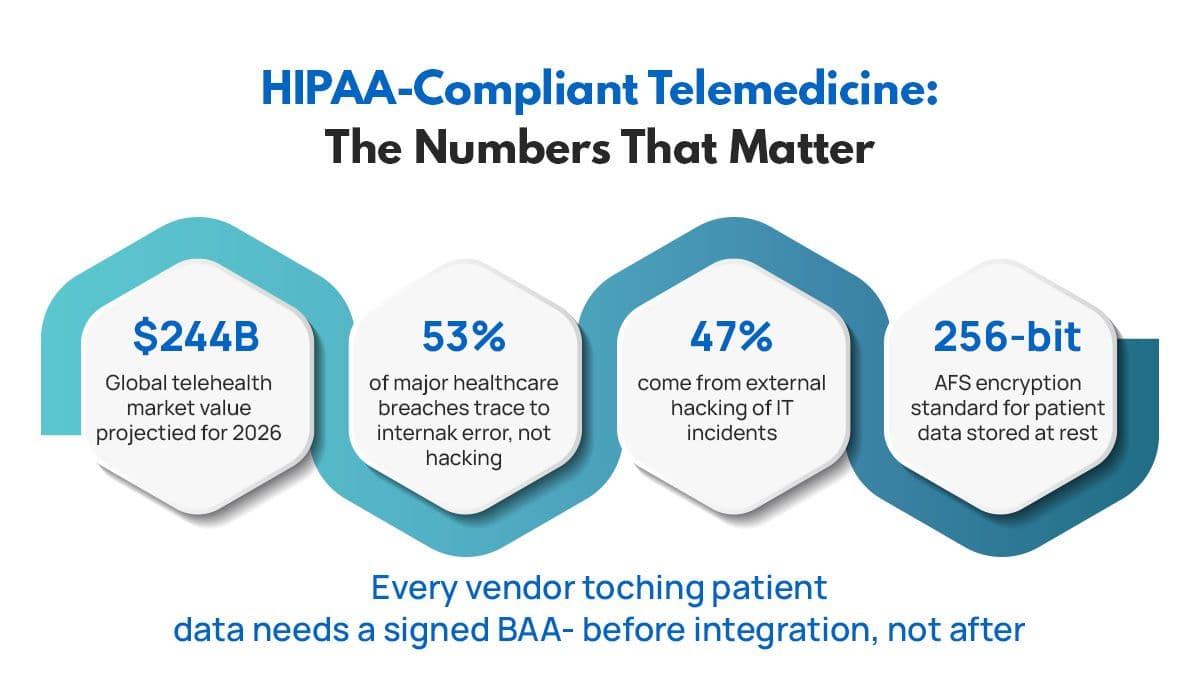
As the global telehealth market is projected to grow to $244 billion by 2026, healthcare providers are faced with the challenge of a rapidly evolving, divergent threat landscape, including the need for built-in security measures across multiple systems.
47% of significant patient data breaches are due to sophisticated external hacking and IT incidents. However, the majority (53%) of patient data breaches are the result of internal administrative and operational shortcomings.
These challenges create the need for a proactive compliance framework. At a minimum, telehealth systems should protect patient data with 256-bit AES encryption, and healthcare entities should protect themselves by executing signed Business Associate Agreements (BAAs) with the telehealth vendors before integrating the systems.
What Features Does HIPAA-Compliant Telehealth Software Provide?
A platform earns the "HIPAA compliant" label by combining these features into one stack:
Secure, encrypted video visits
End-to-end encryption for every session, not just the login screen.
HIPAA-compliant messaging and file sharing
For care-team chat, lab results, and patient documents.
E-prescribing
Integrated with pharmacy networks and controlled-substance rules.
EHR/EMR integration
Syncing with systems like Epic and Cerner so visit notes land where clinicians already work.
Remote patient monitoring (RPM)
Capturing and transmitting device data securely between visits.
Role-based access control and audit logs
So only the right staff see the right records, and every view is traceable.
Signed BAAs with every vendor in the stack
Video, hosting, analytics, and storage included.
Multi-factor authentication
For every clinician and admin login, not just patient-facing ones.
One must meet all of the following criteria to consider themselves a HIPAA compliant telemedicine platform. There are no exceptions, even if they have the most professional-looking platform out there.
How Do You Architect a Compliant Platform?
Cloud Infrastructure and Microservices
Most platforms use a microservices architecture and skip HIPAA compliance builds (BAA signed AWS, Azure, or GCP). This means the platform has independent services to handle video, scheduling, and EHR sync. Having these services isolated means the microservices are not all compromised. It also means the team can scale the video layer without impacting the billing or records.
Encryption In Transit and At Rest
End-to-end encryption should be available for both video and chat. This should include TLS 1.2 + encryption for data in transit and AES 256 for data at rest. The encryption keys should never be part of the data and should be protected in a key management service.
Access Controls and Audit Logging
Controls should be in place so that only authorized users can view Protected health information (PHI). When a record is viewed, audit logs should be created. Regulators look for these logs to be retained for a period of six years, and are typically the first place an investigator will look.
How Do You Secure Patient Data End-to-End?
Signed BAAs With Every Vendor
All third parties that handle PHI (video SDKs, cloud hosts, analytics, transcription services, etc.) must have a signed BAA before any integration. The absence of a BAA is the most common finding in OCR settlements.
Strong Authentication and Session Limits
There are password issues that multi-factor authentication and automatic session timeouts can solve, but there are still gaps that stolen passwords create. Letting patients log in with a password is more than enough; however, staff and admin logins should be more strict.
Monitoring and Incident Response
Unusual log-in patterns that threaten breach detection systems are less of a threat with constant monitoring. In response to a breach, HIPAA requires covered entities to notify the appropriate parties, including staff and patients. Breach response notifications are a documented process.
Which Vendors Offer HIPAA-Ready Options?
Most vendors have tiered systems that offer varying degrees of HIPAA compliance.
Doxy.me
Runs in-browser with no patient download and includes a free-tier BAA, but it doesn't natively connect to major EHRs like Epic or Cerner.
Zoom for Healthcare
An enhanced, HIPAA-compliant version of Zoom, it is also a telemedicine app development tool. Zoom for Healthcare has a business associate agreement, EHR integrations for large health care systems, and all the compliance features for a large system.
Amwell (Converge)
A fully compliant, telemedicine system that integrates directly with EHR systems for enterprise customers.
SolveByte
For teams looking to integrate EHR systems more fully, custom triage logic, or a better patient experience, SolveByte creates fully HIPAA compliant healthcare app development instead of trying to fit a square tool into a round system.
The trade-off to faster implementations becomes deeper system integration, but the longer implementation leads to no trade-offs.
How Should You Plan Your Development Build?
- Creating code without first considering the risk is not a wise first step. Assessing risks first will allow you to create safeguards based on the specific needs of your workflow.
- Identify each vendor that interacts with the patient's data. This allows the team to determine which solutions will be off the shelf, which will be custom, and how much to budget for a compliance review, which will be done before the launch of the product.
At SolveByte, we create telemedicine software solutions that are HIPAA compliant from start to finish, including all layers of the infrastructure as well as the security review. If you are considering a software build, you need to reach out to our team before engaging another vendor.
Bottom Line
Creating a custom telemedicine software solution that is HIPAA compliant is not achieved by simply adding one other feature. It is achieved by having encryption, access controls, signed Business Associate Agreements, and logging of system access combined and integrated at the onset of the project, and will be a result of training and reviewing the controls.
There are numerous readily available solutions, such as Doxy.me, Zoom for Healthcare, and Amwell, that allow a clinic to quickly deploy a telehealth solution. Clinics that have additional needs, such as more extensive integration with their EHR or a specific workflow that a telehealth solution should facilitate, should rely on custom solutions.
Looking for both readily available solutions and custom solutions at one source can fail unless all data is encrypted, all access is logged, and a signed Business Associate Agreement (BAA) is in place for each vendor that will be used to facilitate patient data.
If you are considering a software build, or are looking for some guidance, reach out to SolveByte’s healthcare software team. We are happy to walk through the architecture and compliance needs with you.